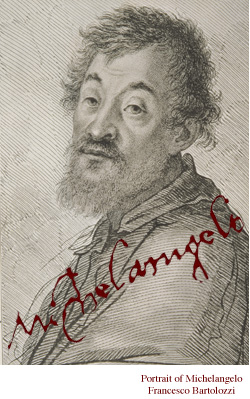
Italian
Renaissance sculptor, painter, architect &
poet
born 1475 - died 1564
Born in: Caprese Michelangelo (Arezzo, Tuscany,
Italy).
Died in: Rome (Lazio, Italy).
Also known as:
Michelangelo Buonarroti, Michel Angel de Bonarrotta,
Michel Aniol, Michelagnolo di Lodovico Buonarroti
Simoni, Michel-Ange, Michelange Bonaroti,
Michel'Angelo, Mighelagnolo, Miguel Angelo,
Mikelandzhelo, Mikel-Andzhelo, Mikilanjilu,
Michelangelo Bonarroti, Michelangelo Bonorotti,
Michelangelo Buonarota, Michel Angelo Buonarroti,
Michelagniolo Buonarroti, Michelagnolo Buonarruoti.
The second of five sons, Michelangelo di Lodovico
Buonarroti Simoni was born in 1475 in the town
of Caprese, located in the Florentine territory
of Italy near Arezzo, Tuscany. The son of a
magistrate, Michelangelo shocked his family
in 1488 by becoming an apprentice to painter
Domenico Ghirlandaio and then studied with sculptor
Bertoldo di Giovanni in the Medici gardens in
Florence. While honing his skills, he was influenced
by prominent people who expanded his views on
the arts, especially Lorenzo de' Medici and
his school, who introduced him to poets, artists,
and scholars in his inner circle.
Early in his career, Michelangelo pursued artistic
perfection in his representation of the human
body. His meticulousness led him to anatomy,
which he studied fervently, even gaining permission
from the prior of the church of Santo Spirito
to study cadavers in the church's hospital.
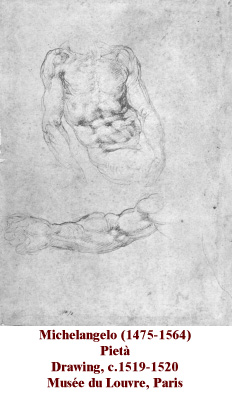
During this time, he began a lifelong practice
of drawing and sketching to prepare for future
works of art and architecture.
Following the death of Lorenzo de' Medici in
1492, Michelangelo left Florence, moving from
Venice to Bologna and eventually Rome, where
he continued sculpting and studying classical
works. During this period the French ambassador
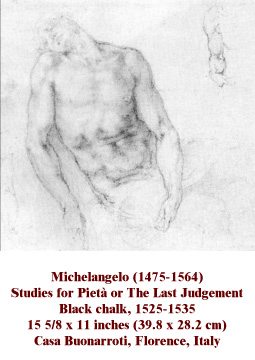
in the Holy See commissioned the "Pietà"
for Saint Peter's Basilica in the Vatican (1498-99).
One of the artist's most famous works, the sculpture
depicts the Virgin Mary mourning over the body
of Jesus Christ after the Crucifixion.
After the fall
of Savonarola and the rise of the gonfaloniere
Pier Soderini, Michelangelo returned home to
the republic of Florence (1501-1505). There
he began work on his famous colossal statue
"David" (1501-1504), created out of
marble from the quarries at Carrara. The masterwork
established his prominence as a sculptor of
extraordinary technical skill and symbolic imagination.
Back in Rome, Pope Julius II (1503-13) commissioned
the artist to create his papal tomb, which features
the famous statue of Moses. Michelangelo worked
on the tomb for 40 years, frequently stopping
work for other commissions, the first major
interruption being the commission to paint in
the Sistine Chapel (1508-12). Michelangelo painted
more than 300 figures on the ceiling. This proved
to be both a mentally and physically arduous
task for the artist, who exhaustively planned
the paintings through his process of drawing
and sketching.
Around 1516, he began to focus more intensely
on architecture. Before leaving Florence definitively
in 1534, he designed plans for the Medici Tombs
and the Laurentian Library attached to the church
of San Lorenzo.
In Rome, Pope Paul III (1534-49) was instrumental
in seeing that Michelangelo produce an enormous
fresco of The Last Judgment in the Sistine Chapel,
where he labored from 1534-1541. A depiction
of the second coming of Christ and the apocalypse,
the work was controversial even before its unveiling
because of the depictions of nude saints in
the papal chapel, which were considered obscene
and sacrilegious.
While completing "The Last Judgment,"
Michelangelo focused his attention back on architecture.
In 1536 he designed the Piazza del Campidoglio,
which rationalized the structures and spaces
of Rome's Capitoline Hill, and in 1546 was appointed
architect of Saint Peter's Basilica and designed
its dome. His last plans were for the Porta
Pia, a gate in the Aurelian Walls of Rome (1561-65).
Michelangelo left his final work in marble,
the "Rondanini Pietà," incomplete.
He died in 1564, nearly 89.










